Agro News
North American Leaders Weigh Climate Strategies in Final Global Ethical Stocktake Dialogue


The Global Ethical Stocktake (GES) held the last of its six Regional Dialogues on Friday (September 19) in New York. Twenty-one leaders—including Indigenous representatives, politicians, religious figures, members of civil society, scientists, activists, and artists—gathered to discuss ways to confront climate change across the continent.
The Global Ethical Stocktake is one of the principal avenues for society to engage with COP30, the UN Climate Conference that will take place this November in Belém, Pará. Framed through ethics and culture, the initiative invites reflection on the progress achieved so far and the urgent measures still required to limit global temperature rise to 1.5°C above pre-industrial levels—the central target of the Paris Agreement. It also examines why such a wide gap persists between what science demands and the actions actually taken to address the root causes of global warming.
The process unfolded over six meetings on six continents in recent months, each led by local leaders who helped galvanize public participation. The ideas shared in these sessions will be compiled into regional reports, which will then serve as the basis for a consolidated summary to be delivered to the COP30 presidency, President Luiz Inácio Lula da Silva, and UN Secretary-General António Guterres at the Pre-COP in October in Brasília. The goal is for the report to inform climate negotiations at the conference.
Friday’s dialogue in New York, which brought the series to a close, also featured Brazil’s Minister of Environment and Climate Change, Marina Silva; the UN Secretary-General’s Special Adviser on Climate Action and Just Transition, Selwin Hart; the President of COP30, André Corrêa do Lago; Brazil’s First Lady and Special Envoy for Women at the conference, Janja Lula da Silva; North America Dialogue Co-Leader and Center for Earth Ethics founder and executive director, Karenna Gore; and Brazil’s Permanent Representative to the United Nations, Sérgio França Danese.

- Minister Marina Silva advocates for the Global Ethical Stocktake to inspire a “new renaissance” of peace with nature at COP30 – Photo: Fernando Donasci/MMA

“May the Global Ethical Stocktake help us bring from different parts of the world a living contribution so that COP30 truly becomes a great collective effort to implement the decisions made over decades,” said Environment Minister Marina Silva. “May this process give us the inspiration needed for a new renaissance of peace, resilience, and reconciliation—among people, with themselves, and with nature,” she added.
Karenna Gore noted that in 2024, for the first time, the 1.5°C threshold was exceeded, according to the European climate observatory Copernicus. At the same time, she stressed that “we have more data, information, technology, and alternative pathways than we have ever had” to confront the crisis.
“That is not enough,” she cautioned. “We need not only information but the wisdom to summon and mobilize it, which requires a deliberate shift in approach. It demands intention and attention—and that is what we are doing here. We are grateful for this call to reflect on our values, our ethics, and the dimensions of human experience we must still examine deeply if we are to face climate change, including our cultural traditions.”
Led by President Luiz Inácio Lula da Silva and UN Secretary-General António Guterres, the Global Ethical Stocktake (GES) was inspired by the first Global Stocktake of the Paris Agreement, concluded at COP28 in Dubai. It rests on the conviction that humanity already possesses the technical solutions for ecological transformation; what is lacking is the ethical commitment to put them into practice. The initiative seeks to chart pathways toward a sustainable and prosperous future, drawing on official science, ancestral knowledge from Indigenous peoples and traditional communities, and climate solutions pioneered by communities worldwide.
The effort also reinforces the global collective action called for by the COP30 Presidency to implement the climate agreements made by nearly 200 countries since the Paris Agreement’s adoption in 2015.
Its central focus lies in the resolutions of the United Arab Emirates Consensus, reached at COP28 following the first Global Stocktake of the treaty. Under the agreement, nations pledged to triple renewable energy capacity, double energy efficiency, halt deforestation, and set a course toward phasing out fossil fuels in a fair, orderly, and equitable way.
Selwin Hart, the UN Secretary-General’s Special Adviser on Climate Action and Just Transition, emphasized that the Global Ethical Stocktake provides one means of addressing the central challenge of the climate crisis: the urgent need for climate justice, ensuring that the countries and populations least responsible for historical greenhouse gas emissions do not bear the greatest burden of their consequences. “We will not give up on hope and courage. Every voice, every action, and every person you influence matters,” he said.
For Ambassador and COP30 President André Corrêa do Lago, the ethical dimension of the climate debate has, in some ways, been lost amid numbers, statistics, and costs. “That is exactly what I have been learning through all these regional dialogues, and it has had a very strong impact on me,” he said. According to him, the essential task now is to determine how these reflections will be brought to the COP30 negotiating table.
Janja Lula da Silva, Brazil’s First Lady and Special Envoy for Women at COP30, said the Global Ethical Stocktake is one avenue to ensure that gender issues remain at the center of the conference’s multilateral process. “We know that climate change increasingly perpetuates inequalities across territories. Climate justice can only be achieved when there is also gender justice,” she affirmed.
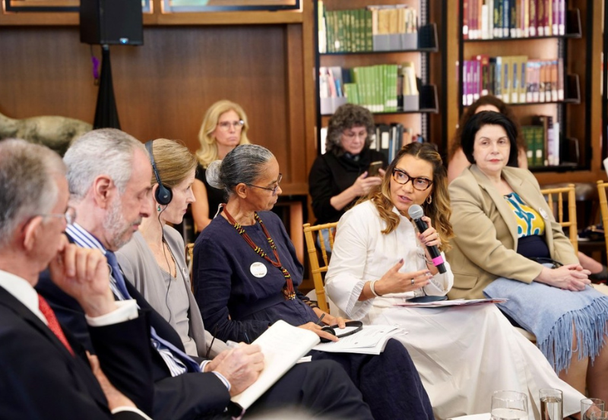
- Janja Lula da Silva, Brazil’s First Lady and Special Envoy for Women at the gathering, called for gender justice as a necessary condition for climate justice during a COP30 dialogue. – Photo: Fernando Donasci/MMA

Road to COP30 in Brazil
The first GES dialogue was held in London, representing Europe; the second in Bogotá, Colombia, for South America, Central America, and the Caribbean; the third in New Delhi, India, for Asia; the fourth in Addis Ababa, Ethiopia, for Africa; and the fifth in Sydney, Australia, for Oceania.
Leadership in these regions was shared by former Irish President Mary Robinson and former Chilean President Michelle Bachelet; Nobel Peace Prize laureate Kailash Satyarthi; Wanjira Mathai, Executive Director for Africa and Global Partnerships at the World Resources Institute (WRI); and former President of Kiribati Anote Tong, respectively.
Alongside the Regional Dialogues, the Global Ethical Stocktake also includes Self-Organized Dialogues, led by civil society organizations as well as national and subnational governments. These follow the same methodology and principles as the central process, with the goal of spreading reflection on the ethical imperative of addressing climate change in a world already grappling with its consequences.
The New York dialogue was hosted at the American Museum of Natural History, organized with support from the Center for Earth Ethics and the Moore Foundation.
Here is the full list of participants in the North America Regional Dialogue of the Global Ethical Stocktake (GES):
Alixa García – Multidisciplinary artist, social justice facilitator, and cultural creator
Angaangaq Angakkorsuaq – Eskimo-Kalaallit elder, shaman, traditional healer, storyteller, and Qilaut carrier
Angel Kyodo Williams – Founder of Transformative Change and architect of the Healing Race Portal, a global intervention to heal the impact of racialization
Angela Daness – Representative of Brazil’s Mission to the United Nations
David Suzuki – Geneticist and broadcaster from Vancouver, Canada; recipient of a UNESCO science award and a medal from the UN Environment Programme
Ambassador André Corrêa do Lago – President of COP30
Enrique Leff – Sociologist, philosopher, and humanist
Fletcher Harper – Executive Director of GreenFaith,an international multifaith grassroots organization dedicated to climate justice
Jacqueline Patterson – Researcher, professor, community organizer, and activist; founder of the Chisholm Legacy Project: A Resource Center for Black Frontline Climate Justice Leadership
James Gustave (Gus) Speth – Environmental lawyer and longtime leader in American environmental thought and action
Jamie Margolin – Writer, filmmaker, community organizer, activist, and speaker of Colombian-American descent; co-founder of the youth climate movement Zero Hour
Janja Lula da Silva – First Lady of Brazil and Special Envoy for Women at COP30
Karenna Gore – Co-leader of the North America Regional Dialogue and Founder and Executive Director of the Center for Earth Ethics
Marco Tedesco – Researcher at Columbia University’s Lamont-Doherty Earth Observatory, member of the Explorers Club, associate professor at the Data Science Institute, and contributor to the Environment and Climate Justice Project
Marina Silva – Brazil’s Minister of Environment and Climate Change
Noelle Young – Consultant for Greenpeace UK; experience in sustainable aquaculture programs in the Caribbean and ocean prosperity projects in Bermuda
Patricia Espinosa – Diplomat with over 40 years of experience in high-level multilateral negotiations and international relations
Robert Bullard – Professor of urban planning and environmental policy; founding director of the Bullard Center for Environmental and Climate Justice at Texas Southern University
Roberto Múkaro Borrero – Kasike (chief) of the Guainía Taíno Indigenous people and President of the United Confederation of Taíno People
Robin Wall Kimmerer – Writer, poet, scientist, and registered member of the Citizen Potawatomi Nation
Selwin Hart – Special Adviser to the UN Secretary-General for Climate Action and Just Transition
Sérgio França Danese – Permanent Representative of Brazil to the United Nations
Sophia Powless – Climate educator, artist, and activist from the Onondaga Nation (Wolf Clan), member of the Haudenosaunee Confederacy (also known as the Iroquois)
Thaddeus Pawlowski – Co-founder and Executive Director of the Center for Resilient Cities and Landscapes at Columbia University
Tzeporah Berman – Climate policy and fossil fuel phase-out expert; International Programs Director at Stand.earth and founding chair of the Fossil Fuel Non-Proliferation Treaty Initiative
Veronica Raya – Senior researcher at the Center for Earth Ethics, focused on local community relations and ceremonial work
Wes Gillingham – Chair of the Northeast Organic Farming Association and co-chair of its policy committee, working on agricultural issues
Yenny Vega Cárdenas – President and co-founder of the International Observatory on the Rights of Nature, and member of the UN Harmony with Nature expert network
Translation by COP30 Communications Office
English Version: Michel Emmanuel Félix François (POET/UFC)
Proofreading: Tadeu Azevedo (POET/UFC)
Assessoria Especial de Comunicação Social do MMA
[email protected]
(61) 2028-1227/1051
Acesse o Flickr do MMA




Cuiabá convoca mais de 170 profissionais para reforçar rede municipal de Saúde

Limpurb retira lixo e vegetação de córrego no bairro Araés

Agricultores familiares aprendem técnicas de produção de silagem para garantir alimentação do rebanho durante a seca

Após anos de espera, paciente do SUS realiza cirurgia vascular em mutirão em Cuiabá

Erro em contratos de arrendamento pode gerar multa de 50% do IR, alerta Receita Federal
-

 Entretenimento9 de agosto de 2026, 15:32
Sabrina Sato se declara a Nicolas Prattes no Dia dos Pais: ‘Seu primeiro Dia dos Pais’
-

 Mato Grosso11 de agosto de 2026, 18:00
Wania Dantas, ex-presidente do CRO-MT, entra no radar para vice de Wellington Fagundes
-

 Cuiabá9 de agosto de 2026, 18:30
Cavalgada e procissão de caminhoneiros marcam último dia do Mato Grosso AgroFestival
-

 Várzea Grande9 de agosto de 2026, 15:00
Cultura leva fantasia e diversão às crianças do CMEI Gervado Bueno em tarde especial de lazer