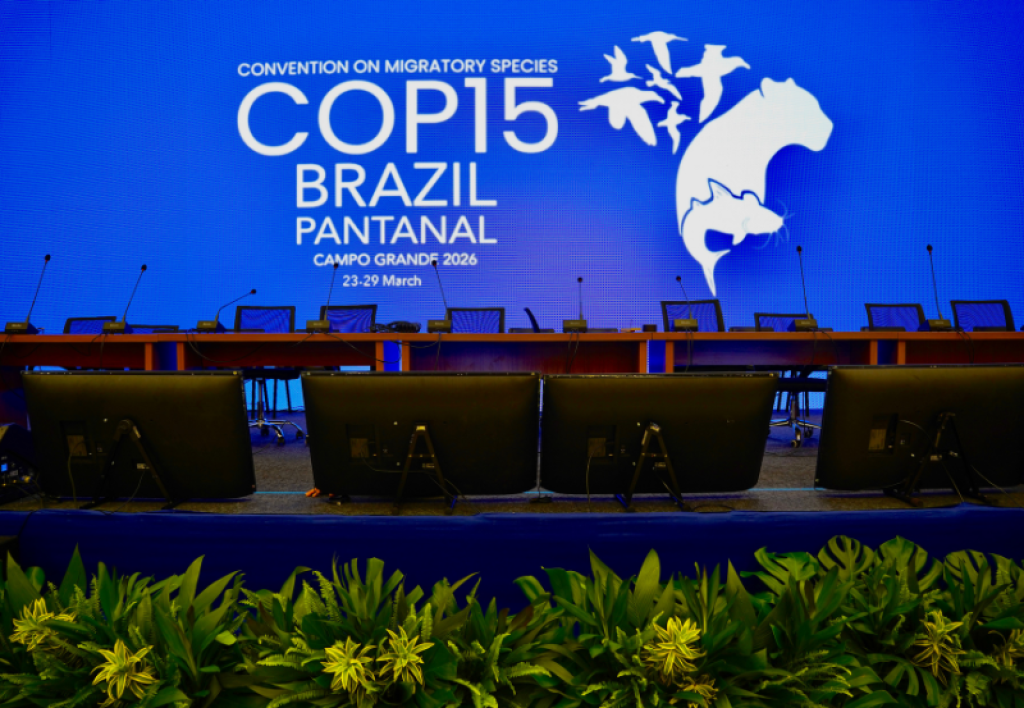
From 23 to 29 March 2026, Brazil will host the 15th Meeting of the Conference of the Parties to the Convention on the Conservation of Migratory Species of Wild Animals (CMS COP15). The meeting will take place in Campo Grande (MS) and will place the country at the epicenter of international discussions on biodiversity and the protection of migratory wildlife.
Learn more about CMS COP15.
Under the leadership of the Government of Brazil and the presidency of the Executive Secretary of the Ministry of the Environment and Climate Change of Brazil (MMA), João Paulo Capobianco, COP15 will bring together governments, scientists, international organizations and civil society to discuss solutions for the conservation of migratory species, their habitats and migration routes.
The programme includes plenary sessions, technical meetings, as well as side events and public events (see more below).
On Sunday (22 March), the High-Level Segment will take place, with the presence of President Luiz Inácio Lula da Silva, the Minister of the Environment and Climate Change, Marina Silva, and the designated President of COP15, João Paulo Capobianco. The President of Paraguay, Santiago Peña, will also attend the session. The objective is to reinforce political commitments and advance international cooperation, guiding global actions that reconcile development, infrastructure and conservation.
General COP15 programme available here.
The official opening of COP15 will take place on Monday (23 March), in the Blue Zone, with political statements by CMS Parties (member countries), the election of the Bureau and the adoption of the agenda. On the same day, countries will present national reports and begin discussions on the Convention’s budget, governance and strategic planning.
Throughout the week, negotiations in the Blue Zone will be held in the Committee of the Whole and thematic working groups, addressing topics such as the conservation status of migratory species, climate change, ecological connectivity and the impacts of human activities. The agenda also includes discussions on action plans for marine, avian and terrestrial species, as well as the review of proposals for the listing and amendment of species in the CMS Appendices.
In addition to formal negotiations, side events, regional meetings and working groups will take place, advancing the Convention’s technical and political discussions.
Check here the list of CMS side events.
Brazil Space and Borderless Connection
Coordinated by the MMA, the Brazil Space, also located in the COP15 Blue Zone, brings together activities in different formats focused on experiences, initiatives and discussions. The agenda complements events organized by the CMS Secretariat, with a focus on international themes connected to the Brazilian context.
Selected proposals involve at least one institution operating in Brazil, linked to governments, civil society organizations and universities, and address native migratory species or those that pass through Brazilian territory, their habitats and related conservation issues.
Click here to access the Brazil Space programme.
In turn, the programme of the Borderless Connection space, organized by the MMA, aims to bring the public closer to discussions on conservation and the climate emergency. With free admission, the initiative brings together efforts from the Government of Brazil, the Government of Mato Grosso do Sul and civil society organizations.
The agenda integrates science, culture and territory, covering topics ranging from the protection of migratory birds and marine ecosystems to the resilience of the Pantanal. The programme includes a socio-environmental film showcase, a photography exhibition and multiple activities.
Access the Borderless Connection programme here.
About CMS
CMS is a United Nations environmental treaty, in force since 1979, that promotes the conservation of migratory species, their habitats and migration routes on a global scale.
The Conference of the Parties (COP) is the main decision-making body of CMS, where 132 countries and the European Union meet to update the lists of species protected under the Convention, the CMS Secretariat budget and the resolutions that guide public policies and conservation initiatives worldwide. The meeting takes place every three years.
CMS brings together governments, scientists, Indigenous Peoples, local communities, civil society and wildlife experts to address challenges related to the conservation of migratory fauna at the global level. In total, approximately 1,189 species are listed in the CMS Appendices, including 962 birds, 94 terrestrial mammals, 64 aquatic mammals, 58 fish species, 10 reptiles and 1 insect.
Special Advisory for Social Communication – MMA
[email protected]
+55 (61) 2028-1227 / 1051
Access MMA’s Flickr
Fonte: Ministério do Meio Ambiente e Mudança do Clima








 Agro News10 de julho de 2026, 12:30
 Política MT9 de julho de 2026, 14:00
 Política MT9 de julho de 2026, 09:31
 Saúde9 de julho de 2026, 10:01