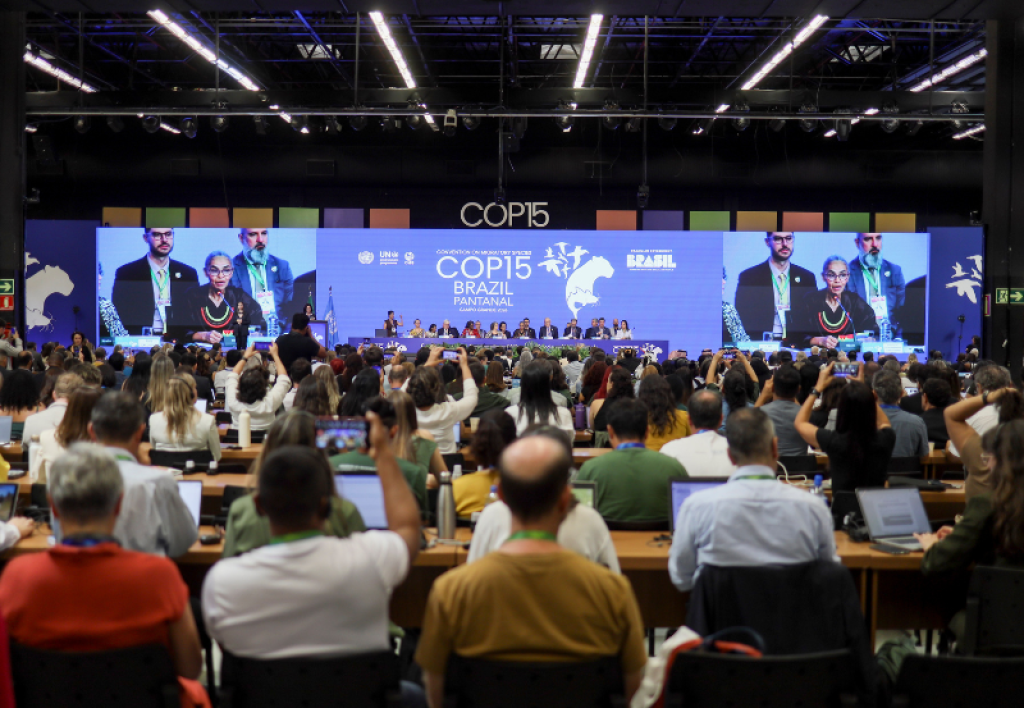
Under the theme “Connecting nature to sustain life,” the 15th Meeting of the Conference of the Parties to the Convention on the Conservation of Migratory Species of Wild Animals (COP15) officially opened this Monday (March 23). The event, which brings together around 2,000 participants in the capital of Mato Grosso do Sul, marks a historic moment for Brazil. For the first time, the country presides over the conference, strengthening its ethical leadership in advancing global socio-environmental commitments.
The Minister of the Environment and Climate Change, Marina Silva, opened the proceedings by highlighting the Pantanal as the ideal setting for the debate. According to the Minister, increasing representativeness in climate decision-making necessarily requires opening spaces for dialogue and including the contributions of Indigenous Peoples and traditional communities (IPTCs).
“The Pantanal is a land of encounters. It is where rivers become lakes, where forests open into fields, where birds from the North and South find a resting place. It is a link that reminds us that nature is not divided by rigid lines, but intertwined through generous transitions. We must connect nations, politics, science, and traditional knowledge to ensure that migratory species can continue their journeys,” said Marina Silva.
The Executive Secretary of the MMA, João Paulo Capobianco, formally assumed the presidency of COP15 for the next triennium, succeeding Uzbekistan (which held the presidency at COP14, from 2024 to 2026). Capobianco emphasized that Brazil’s leadership will be action-oriented.
“We are committed to collaborating with CMS. We aim to seek new accessions and perspectives, leveraging the leadership of President Lula, Minister Marina Silva, and our MMA team to engage other countries. We also want to advance discussions on increasing funding and investment, and to contribute to progress in science and knowledge,” he explained.
Brazil’s leadership was also praised by the Deputy Executive Director of the United Nations Environment Programme (UNEP), Elizabeth Maruma Mrema. “It is very timely that we gather at the gateway to the Pantanal. This biome is a living example of ecological connectivity,” she noted. “COP15 represents a call to action. It is an opportunity to turn words into concrete action, strengthen protection measures, tackle illegal threats, and coordinate efforts along the entire migratory routes of species,” she concluded.
What is on the negotiating table?
The Executive Secretary of CMS, Amy Fraenkel, highlighted that the success of the conference will depend on overcoming both physical and political barriers. In this edition, negotiators are addressing more than 100 agenda items, ranging from combating illegal hunting and habitat loss and fragmentation to addressing the impacts of deep-sea mining and noise and chemical pollution.
“Migratory species are bioindicators of the planet’s health. If they cannot complete their cycles, the entire system fails. We will discuss the inclusion of 42 new species in CMS Appendices I and II [lists of threatened migratory species or those requiring international cooperation for their conservation, respectively], as well as mechanisms for Range States to act in a coordinated manner,” Fraenkel explained. The Government of Brazil proposes, among others, the inclusion of the Pintado (Pseudoplatystoma corruscans), a migratory catfish found in the São Francisco and La Plata river basins.
Currently, CMS protects 1,189 species (962 birds, 94 terrestrial mammals, 64 aquatic mammals, 58 fish, 10 reptiles, and one insect). A species is considered migratory when it crosses national borders in search of food, water, or safe breeding grounds.
Negotiations in plenary and working groups will continue throughout the week. Proposals for listings, resolutions, and decisions that will shape conservation policies for the coming years will be submitted for formal adoption on Sunday (29).
Protecting those who protect
In line with discussions on the protection of migratory species, Minister Marina Silva emphasized the importance of traditional populations for biodiversity and planetary conservation.
“Brazil has chosen to lead by example. That is why yesterday, when President Lula signed the decrees, he ensured they included not only strict protection measures but also sustainable use initiatives,” she added.
On Monday evening, the Migratory Species Champion Night will take place, recognizing CMS Parties for outstanding contributions to the protection of wildlife on the move.
COP15 takes place from 23 to 29 March. Alongside the negotiations, the Government of Brazil is hosting the Brazil Space at the Blue Zone (Bosque Expo), as well as an expanded free program open to the public at the Conexões Sem Fronteiras venue, at Casa do Homem Pantaneiro, in Parque das Nações Indígenas.
Special Secretariat for Social Communication – MMA
[email protected]
+55 (61) 2028-1227/1051
Access MMA’s Flickr
Fonte: Ministério do Meio Ambiente e Mudança do Clima








 Agro News27 de agosto de 2026, 15:30
 Agro News28 de agosto de 2026, 12:01
 Esportes27 de agosto de 2026, 00:31
 Política MT28 de agosto de 2026, 07:01