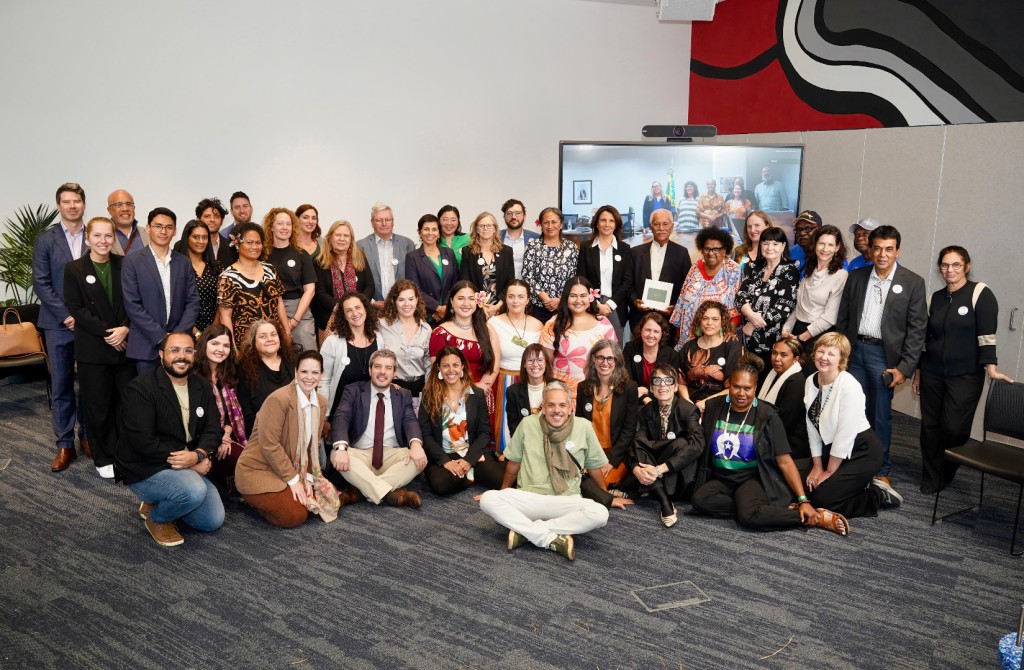
Political leaders, civil society representatives, indigenous voices, climate policy experts, activists and artists gathered in Sydney this Monday (September 15th) for the Oceania Regional Dialogue of the Global Ethical Stocktake (GES). Twenty-six participants shared perspectives on the region’s progress and gaps in climate action, highlighting the urgent need to address the impacts of global warming on people and ecosystems across Oceania.
The GES, one of the four pillars of mobilization for COP30 in Belém, draws inspiration from the first Global Stocktake of the Paris Agreement, concluded at COP28 in Dubai. Through six Regional Dialogues in all continents, the initiative invites reflection on the measures and systemic transformations needed to meet the central goal of the Paris Agreement: limiting global temperature rise to 1.5°C above pre-industrial levels.
The Sydney dialogue — the fifth in the series — included the minister of the Environment and Climate Change of Brazil, Marina Silva (joining remotely); former president of Kiribati and Oceania regional co-leader of the GES, Anote Tong; COP30 CEO, Ana Toni; COP29 President, Mukhtar Babayev (also remotely); the Minister Counsellor of the Embassy of Brazil in Australia, Carlos Pachá; and Germany’s Deputy Consul General to Sydney, Ambassador Klaus Wunderlich.
The GES is based on the principle that humanity already possesses the technical solutions to achieve an ecological transformation; what is lacking is the ethical commitment to implement them. By combining official science, Indigenous knowledge, traditional community practices and grassroots climate solutions, the GES seeks to chart a path toward a sustainable and just future.
The initiative strengthens the “mutirão” convened by the COP30 Presidency to ensure the implementation of climate pledges made by nearly 200 signatories of the Paris Agreement since 2015. Central to these commitments are the resolutions of the United Arab Emirates Consensus, adopted at COP28, which call for tripling renewable energy, doubling efficiency, halting and reversing deforestation and transitioning away from fossil fuels in a fair, orderly, and equitable manner.
For minister Marina Silva, amid a challenging geopolitical context, the Global Ethical Stocktake reveals that cooperation and solidarity are possible. “In the name of multilateralism and climate justice, may we make efforts like the one we are undertaking at this moment: by bringing together different voices and perspectives, and applying an ethical lens to the problems, we show that many of the technical answers have already been given. Now the great challenge is to put into practice an ethic that guides us to implement everything we have already decided, with the aim of preventing further imbalance on our planet,” she stated.
According to Anote Tong, the Paris Agreement represented a redemption for island nations such as Kiribati, of which he was president, whose very existence is threatened by rising sea levels and other consequences of climate change. However, he argued that there is a deficit in fulfilling the decisions agreed under the international treaty. “The issue of fossil fuels remains under debate. Meanwhile, we struggle, people suffer from the impact of storms, our islands are deeply affected by climate change,” he noted. “How can we face these challenges while others engage in activities that destroy the planet? Where is the morality? It is vital that these issues are highlighted, and this dialogue helps make that possible.”
Led by Brazilian President Luiz Inácio Lula da Silva and UN Secretary-General António Guterres, the GES will produce six regional reports and one synthesis document to be presented at the Pre-COP meeting in Brasília this October. The final report will help inform the negotiations at COP30.
Ana Toni, CEO of COP30, underlined the importance of courage in the upcoming talks. “The GES gives us the strength and energy we need to do our work”, she said, highlighting that, at COP30, negotiators must have the courage to do the right thing.
“This dialogue is about ethics. It is about ensuring that moral duty becomes a guiding principle of climate diplomacy. We must begin by holding donors accountable for the promises already made, from Rio de Janeiro to Paris and from Baku to Belém and beyond,” said Mukhtar Babayev, referring in particular to the increase in climate finance from US$300 billion to US$1.3 trillion annually by 2035, with developed countries taking the lead in the process, as agreed at COP29 in Baku, Azerbaijan.
Road to COP30
The first GES meeting was held in London, United Kingdom, representing Europe; the second in Bogotá, Colombia, representing South and Central America and the Caribbean; the third in New Delhi, India, representing Asia; and the fourth in Addis Ababa, Ethiopia, representing Africa. The role of co-leader in these regions was taken on by former presidents of Ireland and Chile, Mary Robinson and Michelle Bachelet, Nobel Peace Prize laureate Kailash Satyarthi, and the World Resources Institute (WRI) managing director for Africa and Global Partnerships, Wanjira Mathai, respectively.
The next and final dialogue will take place in New York, United States, representing North America, under the co-leadership of the founder of the Center for Earth Ethics, Karenna Gore.
In addition to the Regional Dialogues, the GES includes Self-Organized Dialogues, promoted by civil society organizations and national and subnational governments, following the same methodology and principles as the central process. The aim is for these meetings to help spread reflection on the ethical imperative of confronting climate change in a world already experiencing its effects.
The Sydney meeting was held at the Greenhouse Tech Hub and was organized with the support of the Australian Government’s Department of Foreign Affairs and Trade, the German Federal Ministry for the Environment, and the Deutsche Gesellschaft für Internationale Zusammenarbeit (GIZ).
List of Participants – Oceania Regional Dialogue of the Global Ethical Stocktake (GES):
-
Amanda Cahill, founder of The Next Economy, which supports regional communities in Australia in managing the impacts of climate change in a regenerative way;
-
Ana Toni, CEO of COP30;
-
Anote Tong, former President of Kiribati and co-leader of the Oceania Regional Dialogue of the GES;
-
Belyndar Rikimani, lawyer for the Government of the Solomon Islands and President of Pacific Islands Students Awareness;
-
Brianna Fruean, climate activist from Samoa and member of the Pacific Climate Warriors Council of Elders;
-
Carlos Pachá, Minister-Counsellor of the Embassy of Brazil in Australia;
-
Cathyrn Eatock, Co-Chair of the Indigenous Peoples Organization of Australia (IPOA), Pacific member of the Facilitative Working Group (FWG) of the Local Communities and Indigenous Peoples Platform (LCIPP) of the UNFCCC, 2022–25;
-
Daisy Barham, Climate Change Program Manager at the Australian Environmental Grantmakers Network (AEGN), supporting more than 200 members in the fight against climate change;
-
Ambassador Klaus Wunderlich, Deputy Consul General of Germany in Sydney;
-
Ian Fry, expert in international environmental law and human rights policy;
-
Jacinda Ardern, Oceania envoy for the COP30 Presidency and former Prime Minister of New Zealand;
-
Jacqueline Peel, leader of the COP Universities Alliance and expert in environmental law and climate change;
-
Larissa Baldwin-Roberts, founder of Common Threads, a new First Nations–led organization working to strengthen First Nations leadership and advocacy;
-
Linh Do, Director of the Wattle Fellowship, the University of Melbourne’s flagship sustainability leadership initiative;
-
Marina Silva, Minister of the Environment and Climate Change of Brazil;
-
Maureen Penjueli, former Director of the Pacific Network on Globalisation (PANG);
-
McRose Elu, member of the Australian Religious Response to Climate Change (ARRCC);
-
Mukhtar Babayev, President of COP29;
-
Okalani Mariner, climate activist, artist, poet, and social entrepreneur from Samoa, as well as National Coordinator of 350.org Samoa;
-
Pabai Pabai and Paul Kabai, climate justice advocates, First Nations leaders from the Torres Strait Islands, and traditional owners of Saibai and Boigu;
-
Rebecca Burden, CEO of Climate Resource, an organization focused on climate change and policy;
-
Richard Dennis, Executive Director of the Australia Institute;
-
Richie Merzian, CEO of the Clean Energy Investor Group;
-
Sharan Burrow, Vice-President of the European Climate Foundation and Visiting Professor at the LSE Grantham Institute;
-
Thelma Raman, Senior Consultant at E&SCO – Education and Sustainability Consulting Oceania, with more than 25 years of experience in education and sustainability;
-
Tiana Jakicevich, environmental protection and climate action advocate – her work spans Aotearoa and the Pacific, where she is at the forefront of efforts to phase out fossil fuels.
Fonte: Ministério do Meio Ambiente e Mudança do Clima







 Política MT22 de setembro de 2026, 09:02
 Agro News22 de setembro de 2026, 08:03
 Política MT23 de setembro de 2026, 07:32
 Esportes22 de setembro de 2026, 00:02